Whale Watching Kona Hawaii — Season Dates, Best Tours, and What You'll Actually See

Every winter, approximately 10,000 North Pacific humpback whales migrate from their feeding grounds in Alaska to the warm, shallow waters around the Hawaiian Islands to breed and give birth. Kona Hawaii sits on the western leeward side of the Big Island, where the calmer waters and submarine topography of the Kona coast make it one of the best places in Hawaii to watch humpbacks from a boat — close enough to hear them singing through an underwater hydrophone. The season is short and specific. This guide covers exactly when they arrive, when they leave, and what to expect on a Kona whale watching cruise. Season by season, the seasonal picture across every Kona activity sets the rest of the calendar. Season aside, the best time to visit Kona sets out the month-by-month weather normals, and Kona or Hilo covers which coast to sleep on while the whales are here.
About This Activity
Up to 24h in advance — full refund
Book your date today, pay nothing until later
Departs Honokohau Harbor — snacks and beverages included
Hear humpback whale song in real-time through a submerged microphone — one of the most haunting sounds in nature
Kona's leeward waters are a primary calving ground — you're likely to see mothers with newborn calves
No whales spotted? You get another cruise free — Hang Loose Boat Tours, 4.8★, 289 reviews
Check Live Availability — Seasonal December Through April
Real-time dates for the Kona whale watching cruise. This tour operates December through mid-April only — book early, particularly for January and February, when whale density peaks.
Whale Watching Season in Kona Hawaii — When to Go
When Do Whales Arrive in Kona Hawaii?
Humpback whales begin arriving in Hawaiian waters in late November and early December, migrating south from their summer feeding grounds in the North Pacific (primarily the waters around Alaska and British Columbia). The Kona coast on the Big Island's western side is one of the first areas to see arrivals, as whales move through the channel between the Big Island and Maui.
The season builds through December, peaks in January and February, and begins to decline in March as whales start the return migration north. By mid-April, the vast majority of humpbacks have left Hawaiian waters, and whale watching tours for the year are finished until the following December.
If you're visiting Kona specifically for the whale watching, January and February are the optimal months: highest whale density in the water, most active surface behavior (breaching, tail slapping, pec slapping), and the greatest chance of hearing complex male song on the hydrophone.
- First arrivals: late November to early December
- Peak season: January and February — highest whale density and most active behavior
- Season end: mid-April — most whales have departed by then
- Tour availability: December through mid-April only (the whale watching cruise on the Big Island is a seasonal product)
- Best months to book: January and February for the full experience
Why Humpback Whales Come to Hawaii — and Why Kona Specifically
Humpback whales migrate to Hawaii to breed and calve — the warm, shallow Hawaiian waters (70–80°F) are ideal for newborn calves, which are born without the thick blubber layer that protects adults in cold Alaskan waters. Calves are born at approximately 14 feet long and 2,000 pounds. Their mothers nurse them on high-fat milk for the first months of life in Hawaii before the return migration north.
Kona's leeward (western) coastline is particularly attractive to humpbacks for several reasons: the calm waters protected by the island's mass from trade wind swell, the shallow submarine shelves off the coast that provide suitable calving depth, and the relative absence of boat traffic compared to the channels between Maui and the other islands. You are more likely to see mother-calf pairs in the waters off Kona than in many other Hawaii locations.
Male humpbacks sing in Hawaii — complex, evolving songs that can last 20–30 minutes and are audible underwater for miles. The hydrophone on the Hang Loose whale watching cruise picks up this song and broadcasts it on deck. Hearing a humpback whale sing in real-time, while the animal is 50 meters from the boat, is one of the more affecting natural experiences available anywhere.
- Reason for migration: warm water for calving — newborns lack cold-water blubber
- Calf size at birth: approximately 14 feet long, 2,000 pounds
- Why Kona's waters: calm leeward coast, shallow shelves, calving depth, less boat traffic
- Male song: humpback males sing for 20–30 minutes at a time — audible for miles underwater
- Population: approximately 10,000 North Pacific humpbacks make this migration annually
Hawaii Humpback Whale Population — Numbers and Conservation Status
The North Pacific humpback whale population hit a low of approximately 1,400 individuals in the 1960s before the international whaling moratorium (1966) and US protections under the Marine Mammal Protection Act (1972). The population has recovered dramatically — current estimates put the North Pacific humpback population at approximately 10,000–12,000 individuals, up from the near-extinction low 60 years ago.
Hawaii humpbacks were listed as endangered under the US Endangered Species Act until 2016, when they were delisted due to the successful population recovery — one of the genuine conservation success stories of the 20th century. The whales are still federally protected: boats are required to maintain a 100-yard distance from all humpbacks (300 yards for mother-calf pairs).
Licensed whale watching operators in Hawaii are permitted to approach within the legal distance and are trained to read whale behavior. If a whale approaches the boat voluntarily, the operator is not required to move away — some of the closest encounters on these tours happen when curious whales come to the boat unprompted.
- 1960s low: ~1,400 individuals — near extinction due to commercial whaling
- Current population: ~10,000–12,000 North Pacific humpbacks
- Delisted from endangered in 2016 — conservation success story
- Federal protection: 100-yard minimum approach distance (300 yards for mother-calf pairs)
- Voluntary approaches: if a whale comes to the boat, operators are not required to move
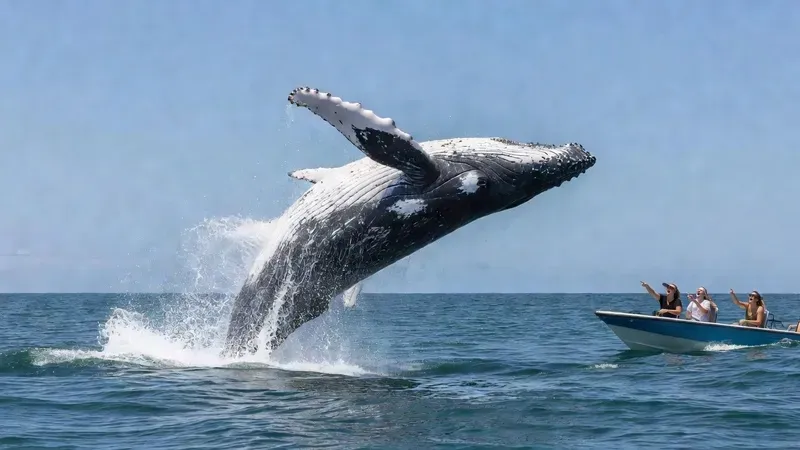
A humpback breach off the Kona coast. Whales breach for reasons researchers still debate — communication, parasite removal, play, or courtship. On peak January and February days, one boat may witness 20+ breaches.
What to Expect on a Kona Whale Watching Cruise
The Hang Loose Whale Watching Cruise — What Actually Happens
The Hang Loose whale watching cruise departs from Honokohau Harbor, 2 miles north of Kailua-Kona, and runs 2.5 hours on open water. Hotel pickup from Kona and Kohala Coast hotels is included — confirm pickup timing when booking.
Once underway, the captain uses local knowledge and radio contact with other operators to find active whale aggregations. Kona's whale population concentrates in the waters between 1–5 miles offshore, where the seafloor drops from shallow calving shelves into deep open-ocean terrain. The transition zone is where whales are most active.
The hydrophone is the standout feature of this specific tour: a submerged microphone broadcasts whale song in real-time through the boat's speaker system. Male humpbacks sing continuously throughout the Hawaiian season — the songs are complex, eerie, and clearly audible on the boat deck when a singing whale is within range. Having the song playing while a whale surfaces 100 meters away is a moment most passengers remember for years.
- Departure: Honokohau Harbor (2 miles north of Kailua-Kona) — hotel pickup included
- Duration: 2.5 hours on the water
- Hydrophone: live humpback song broadcast on deck speakers in real-time
- Snacks and beverages included on board
- Free re-cruise guarantee: no whales spotted = complimentary repeat booking
Whale Behaviors You'll See — What Each One Means
Humpbacks are among the most surface-active of all whale species — which is why whale watching in Kona is so rewarding compared to searching for species that rarely surface dramatically. Here's what the common behaviors actually mean:
Breach: The whale propels its entire body (or most of it) out of the water and lands with a tremendous splash. The most visually dramatic behavior. Researchers believe breaching may serve communication, parasite removal, or social display functions. On a peak January or February day off Kona, you may see 10–20 breaches from multiple individual whales.
Pec slap (pectoral fin slap): The whale rolls to one side and slaps its long pectoral fin (which can reach 15 feet in length) against the water surface repeatedly. The sound carries for miles. Often associated with social interaction or communication.
Tail slap (lobtailing): The whale raises its tail out of the water and slaps it against the surface. Similar communication function to the pec slap. Frequently observed when whales are near other whales.
Spy hop: The whale raises its head vertically out of the water — eyes above the surface — holds position, then slips back under. The whale is looking. This is not breaching; the movement is slow and deliberate.
Blow: The most common sighting — the whale's breath as a 10–15 foot column of vapor when it surfaces to breathe. Identifies position and direction of travel. The blow from a humpback has a distinctive bushy, bushy shape.
Fluke display (sounding): When a humpback dives deeply, it raises its tail flukes vertically above the surface — a classic postcard image. Flukes are unique to each individual (like fingerprints) and are used by researchers to identify specific animals.
- Breach: full body launch — most dramatic, reasons still debated
- Pec slap: lateral fin slap — communication and social interaction
- Tail slap (lobtailing): tail slaps the surface — similar to pec slap in function
- Spy hop: vertical head-raise, eyes above water — the whale is looking at you
- Blow: visible breath column — the most frequent sighting, 10–15 feet tall
- Fluke display: tail raised on deep dive — unique pattern used to ID individuals
Whale Watching from Shore in Kona Hawaii — Free Viewing Spots
During peak whale season (January–February), humpbacks are visible from shore along the entire Kona coast — often within a mile or two of land. You don't always need a boat.
Palani Road overlook and Ali'i Drive corridor: The road along Kailua-Kona's waterfront provides elevation (especially at the upper parking areas near Costco and the intersection with Hwy 19) for scanning the ocean. Binoculars or a long lens camera are useful; the naked eye can spot large breaches on calm mornings.
Mauna Kea Beach Hotel and Mauna Lani grounds: The elevated coastal terraces at the Kohala Coast resorts give excellent sightlines several miles out to sea. During morning hours on calm days, breaching is frequently visible from the pool and beach areas.
Honokohau Harbor: The harbor mouth overlooks the open ocean directly. Humpbacks regularly pass through the channel between the harbor and the offshore marine protected area during peak season.
From shore, you're watching at a distance of 1–3 miles — you'll see breaches and blows but not the close-range detail of a boat tour. The hydrophone experience, the mother-calf proximity, and the boat crew's narration are what justify the tour cost.
- Best shore spot: upper Ali'i Drive / Palani Road overlook in Kailua-Kona
- Bring: binoculars or long lens — 1–3 mile distance from shore
- What you'll see: breaches and blows visible; fine detail requires a boat
- Best time for shore watching: 7–11am before afternoon trade winds start
- Peak shore visibility: January and February during the highest whale density
Practical Guide — What to Know Before Your Kona Whale Watching Tour
Whale Watching Sighting Rate and the No-Whale Guarantee
Whale watching anywhere is wildlife, not performance — no responsible operator guarantees a sighting. The Hang Loose whale watching cruise in Kona does the next best thing: if no whales are spotted, you receive a complimentary re-cruise at no charge.
In practice, the no-whale outcome is rare during peak season. January and February have the highest density of humpbacks in Hawaiian waters, and the Kona coast's configuration means whales are often visible within minutes of leaving the harbor. The more common outcome is seeing multiple individuals, witnessing active behavior (breaching, pec-slapping, spy-hopping), and hearing whale song on the hydrophone — all in a 2.5-hour window.
Early December and late March/early April tours are lower-probability — fewer whales in the water at the beginning and end of the migration window. If your Kona trip falls in these shoulder periods, still book the tour, but set expectations for a quieter experience.
- Sighting rate: very high in January–February; lower at season edges (early December, late March–April)
- No-whale policy: Hang Loose offers a complimentary re-cruise if no whales are spotted
- Peak activity: mornings tend to be calmer with more surface behavior; afternoons more wind and chop
- Multiple-whale days: January and February often produce 5–15 individual whale sightings per cruise
Motion Sickness on Kona Whale Watching Cruises
Kona's leeward coast is protected from trade wind swell by the island's mass, making it calmer than the channels between islands. That said, some ocean motion is unavoidable on a 2.5-hour offshore cruise, especially in the afternoons when trade winds build from the northeast.
If you're prone to motion sickness, take preventive medication (Dramamine, Bonine, or scopolamine patch) at least 30–60 minutes before departure — not after you feel ill, when it's too late to work. Sit on the deck rather than below, keep your eyes on the horizon, and stay in the fresh air. The boat's forward motion creates some air circulation that helps.
Morning departures are almost always calmer than afternoon runs — if motion sickness is a concern, choose the earliest available departure.
- Take motion sickness medication 30–60 minutes before departure — not after symptoms start
- Sit on deck, not below — fresh air and a visible horizon help
- Morning departures are calmer — afternoon trades increase chop
- Recommended: Dramamine (drowsy), Bonine (less drowsy), or prescription scopolamine patch
Not Suitable For and What to Bring
The whale watching cruise is accessible to most visitors, with a short list of physical restrictions.
- Not suitable for: pregnant women (open-ocean boat in variable conditions)
- Not suitable for: people with serious heart or back conditions
- What to bring: sunscreen and a hat (2.5 hours on open water — shade is limited), sunglasses, a light jacket or windbreaker (ocean temperature and spray can make the boat cold even on a warm day), binoculars if you have them, motion sickness medication if needed
- What to bring: camera with zoom lens — whale photography rewards distance and patience; a 200–400mm equivalent is useful
- Not allowed: approaching or feeding wildlife — the crew maintains all required federal distances
Whale Watching Kona Hawaii — Frequently Asked Questions
When is whale watching season in Kona Hawaii?
Whale watching season in Kona Hawaii runs December through mid-April, when North Pacific humpback whales migrate to Hawaiian waters to breed and calve. The peak of the season is January and February — the highest whale density, most active surface behavior (breaching, pec-slapping, spy-hopping), and the best chance of hearing male humpback song on the hydrophone. By mid-April, the majority of whales have begun the return migration to Alaskan feeding grounds.
Are there humpback whales in Kona Hawaii year-round?
No. Humpback whales are only present in Kona Hawaii waters from December through mid-April. Outside this window, they are in their North Pacific feeding grounds off Alaska and British Columbia. If you're visiting Kona outside whale season (May through November), whale watching tours don't operate. Other marine wildlife — manta rays, spinner dolphins, sea turtles, green sea turtles — are present year-round.
How close do you get to humpback whales on a Kona whale watching tour?
Federal regulations require licensed whale watching boats to maintain a minimum of 100 yards from humpback whales (300 yards for mother-calf pairs). In practice, this still puts you very close — within the length of a football field. When whales approach the boat voluntarily (which happens), operators are not required to back away, and some of the closest encounters on these tours occur when curious whales investigate the boat on their own.
Can you hear humpback whales singing during a Kona whale watching cruise?
Yes — the Hang Loose whale watching cruise includes an underwater hydrophone that broadcasts humpback song in real-time through the boat's speakers. Male humpback whales sing complex, evolving songs throughout the Hawaii breeding season — the same basic song is sung by all males in the North Pacific population, but it changes incrementally over the course of the winter. Hearing a whale sing while it is visible at the surface 100 meters from the boat is one of the more singular natural experiences available on the Big Island.
What other marine life can you see on a Kona whale watching cruise?
Beyond humpback whales, Kona whale watching cruises regularly encounter spinner dolphins (common year-round, often in large pods of 50–200 animals), green sea turtles at the surface, and occasionally pilot whales or false killer whales. Flying fish are frequently seen leaping ahead of the boat. On rare occasions, sperm whales or blue whales are reported in the deep offshore waters of the Kona coast.
Is whale watching in Kona Hawaii worth it?
For visitors in Kona between December and April, yes — humpback whales are one of the most impressive animals on Earth, and Kona's whale watching cruise puts you in the water with them at very close range for 2.5 hours with hotel pickup included. The hydrophone song experience and the free re-cruise guarantee make the Hang Loose cruise in particular good value at $115 per adult. If your visit falls outside whale season (May through November), the manta ray night snorkel is the comparable marine wildlife experience that runs year-round.
Can you see whales from shore in Kona Hawaii?
Yes, during peak season (January–February), humpbacks are frequently visible from the Kona shoreline — breaching and blowing within 1–3 miles of land. Good shore viewing spots include the elevated areas along Ali'i Drive and Palani Road in Kailua-Kona, the Honokohau Harbor entrance area, and the Kohala Coast resort terraces. Binoculars are useful. Shore viewing is free but you see much less detail than from a boat, and you won't hear the hydrophone or have a knowledgeable guide narrating the behavior.
Do whale watching tours in Kona operate year-round?
No — whale watching tours in Kona Hawaii operate December through mid-April only, aligned with the humpback whale season. Outside these dates, no whale watching tours are available because the whales have returned to Alaska. Check live availability dates above to see currently bookable departures. If you're visiting outside whale season, the manta ray night snorkel and Kealakekua Bay snorkeling are the top marine wildlife alternatives.