Hawaii Forest & Trail Mauna Kea Summit Stargazing Tour from Kona — What You See at 13,796 Feet

The Hawaii Forest & Trail Mauna Kea summit stargazing tour takes a group of no more than 12 people to the summit of Mauna Kea — at 13,796 feet above sea level, the highest point in Hawaii and, measured from the ocean floor, the tallest mountain on Earth. The tour covers the summit sunset, a private 11-inch Celestron telescope session, digital astrophotography, and a summit descent to a mid-elevation meadow for dinner. At $330, it is the most expensive per-activity experience in Kona and, by most accounts of the 14 verified reviewers, worth every cent. Price it against the Big Island's other headline experiences before you commit.
About This Activity
Up to 24h in advance — full refund
Book today, pay nothing until later
Afternoon departure from Waimea (Kamuela) — returns after midnight
Dedicated astronomical telescope for deep-sky and planetary observation — not a shared tour scope
Summit permits limit group size — intimate, unhurried experience at the top
Hawaii Forest & Trail — the original Mauna Kea summit tour operator, running since 1993
Check Live Availability — Minimum 4 Guests Required
Real-time availability for the Hawaii Forest & Trail Mauna Kea summit tour. Minimum 4 guests required for the tour to operate. Maximum 12. Book in advance — summit permits are limited.
What Happens at 13,796 Feet — The Complete Summit Experience
The Ascent — From Waimea to the Summit
The tour departs from Waimea (Kamuela) in the afternoon — a central location on the Big Island that serves as the staging point for the summit climb. The ascent covers the full elevation gradient of Mauna Kea: from the warm coastal lowlands through the agricultural midlands, into the cloud layer at 6,000–8,000 feet, and finally above the clouds into the thin air of the upper mountain.
The summit road above the visitor center (at 9,200 feet) is a 4WD-only route on unpaved cinder. Hawaii Forest & Trail operates vehicles with the permits and equipment for the upper mountain. Guests spend approximately 45 minutes at the summit before the road closes to private vehicles for the evening.
Parkas are provided for the summit — temperatures at 13,796 feet are typically 30–45°F in the afternoon and drop further after sunset. Wind is variable but can make it significantly colder. The air at the summit contains 40% of the oxygen available at sea level — guests who are sensitive to altitude may experience lightheadedness, and the operator acclimitizes with a stop at the Onizuka Center for International Astronomy at 9,200 feet before the summit push.
- Departure: Waimea (Kamuela) — afternoon start
- Acclimation stop: Onizuka Center at 9,200 feet — 30-minute rest before summit push
- Summit: 13,796 feet — 40% of sea-level oxygen content
- Temperature: 30–45°F at the summit; parkas provided
- Summit time: approximately 45 minutes before road closure for private vehicles
- Minimum age: 13 years — altitude effects are more pronounced in children
Sunset at the Summit — What You're Actually Seeing
The summit sunset at Mauna Kea is one of the most photographed phenomena in Hawaii — a combination of high altitude, isolation, and the presence of the famous white telescope domes creates an image that defines the Big Island for many visitors.
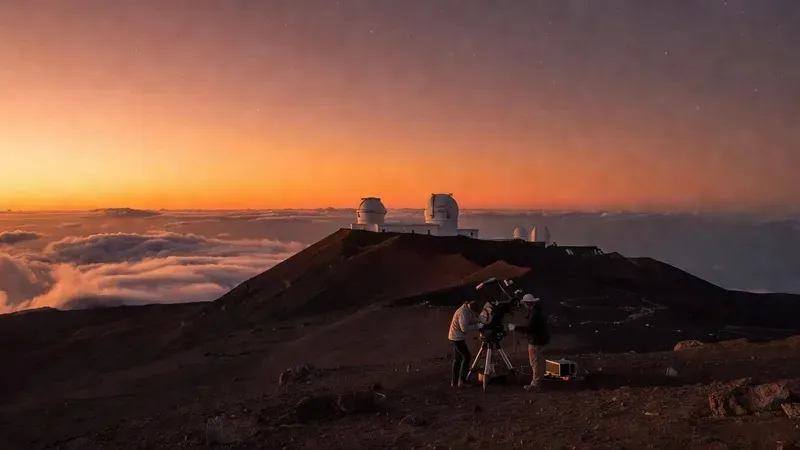
From 13,796 feet, the sunset visibility extends beyond what's possible at sea level. You are above most of the atmosphere's water vapor and dust, which means colors are more saturated and the horizon is sharper. The cloud layer that covers the island (visible from the summit as a soft white blanket 6,000 feet below) catches the sunset light from above — turning gold, then pink, then deep purple as the sun drops. This is the inverse of watching a sunset from the shore: you are above the clouds, not beneath them.
The observatory domes — operated by the University of Hawaii, Caltech, and thirteen other institutions — are silhouetted against the sunset. The summit is a genuinely active astronomical research site, and the observatory buildings give the landscape an otherworldly appearance that photographs unlike anything else in Hawaii.
- Altitude: above the cloud layer — you watch clouds glow gold from above, not below
- Clarity: thin atmosphere = saturated colors and sharp horizon
- Observatory domes: silhouetted against the sunset — 13+ research telescopes at the summit
- Temperature drop: sunset brings rapid temperature drop — parkas essential
- Photography: wide angle + telephoto needed — both the distant dome-silhouette and the close color sky
The 11-Inch Celestron Telescope — Deep-Sky and Planetary Viewing
After the summit visit, the tour descends to a mid-elevation site below the cloud layer for the telescope session. The Hawaii Forest & Trail telescope is an 11-inch Celestron SCT (Schmidt-Cassegrain) — a professional-grade instrument significantly more powerful than the typical consumer binoculars or 4-inch scopes offered on casual stargazing tours.
At this aperture, the targets include:
Deep-sky objects: Nebulae (the Orion Nebula shows color and structure), open and globular star clusters (Hercules cluster resolves into individual stars), galaxies (Andromeda shows core and halo structure)
Planets: Saturn's rings are clearly defined with visible ring gap; Jupiter's bands and four Galilean moons are individually visible; Mars shows polar ice caps at opposition
The Moon: when present, the crater detail at 11 inches is extreme — individual craters the size of Hawaiian counties are visible
The guide operates the telescope and targets objects based on the season and sky conditions. The digital astrophotography component captures long-exposure images through the telescope — guests receive their astro-photography as a digital souvenir.
- Telescope: 11-inch Celestron SCT — professional-grade aperture, not a consumer scope
- Deep-sky: nebulae with color and structure, globular clusters resolving to individual stars
- Planets: Saturn's rings with Cassini Division visible; Jupiter's bands and 4 moons; Mars polar caps
- Digital astrophotography: long-exposure images through the scope — guests receive digital copies
- Guiding: naturalist astronomer operates the scope and explains each target
Picnic Dinner at Mid-Elevation
A picnic dinner is served at the mid-elevation stargazing site — timed between the summit visit and the full night's telescopic viewing. The elevation at the dinner site (approximately 9,000 feet) means the air is clear but the temperature is warmer than the summit. The dinner is a break in the stargazing session, not a full restaurant meal.
The minimum 4 guests requirement is an important logistical note: if fewer than 4 guests are booked for your departure date, the tour may be cancelled and you would be transferred to another date. Book with this in mind, especially if you have a fixed travel schedule.
- Dinner: picnic-style at the mid-elevation stargazing site (~9,000 ft) — included
- Timing: between summit sunset visit and full-night telescopic viewing
- Minimum 4 guests: if your departure is underbooked, you may be moved to another date — confirm close to travel
- Return: after midnight — plan your following morning accordingly
The Mauna Kea summit at sunset — 13,796 feet above sea level, above the cloud layer. The white observatory domes are operated by 13+ institutions including NASA and the University of Hawaii. The cloud layer 6,000 feet below glows gold in the evening light.
Who This Tour Is Best For — and the Altitude Reality
Who Should Book the Mauna Kea Summit Tour
The Hawaii Forest & Trail Mauna Kea summit stargazing tour is the right experience for:
- Best for: serious stargazers who want the most capable astronomical telescope available on a guided tour in Hawaii
- Best for: visitors for whom the Mauna Kea summit itself is a goal — the highest point in Hawaii at 13,796 feet
- Best for: photography enthusiasts interested in astrophotography — the digital images through the 11-inch scope are the most technically impressive astro-photography available on any Kona tour
- Best for: travelers who want a small-group, expert-led experience (maximum 12) rather than a lecture-format large tour
- Best for: visitors who've already seen Kilauea and want the night experience at maximum elevation
Not Suitable For and Altitude Safety
The altitude is the primary consideration for booking this tour — 13,796 feet is not a trivial elevation, and guests should assess their own health honestly:
- Not suitable for: pregnant women — high altitude is contraindicated during pregnancy
- Not suitable for: children under 13 years — altitude effects are more pronounced in children
- Not suitable for: guests with heart conditions, respiratory conditions, or high blood pressure — confirm with your doctor before booking high-altitude activities
- Altitude reality: at 40% oxygen, even healthy guests may experience lightheadedness, headache, or nausea at the summit. This is normal and typically resolves on descent
- What to bring: warm clothes (multiple layers for 30–45°F summit temperatures plus wind chill), a hat, gloves, and windproof outer layer — parkas are provided but an insulating mid-layer helps
- What to bring: camera with wide-angle and telephoto capability for summit photography; tripod strongly recommended for astrophotography through the telescope
Mauna Kea Summit Stargazing Tour — Frequently Asked Questions
How high is Mauna Kea and what does altitude feel like?
Mauna Kea's summit is 13,796 feet (4,205 meters) above sea level. At this elevation, the air contains approximately 40% of the oxygen available at sea level. Healthy adults typically experience mild symptoms: slight breathlessness, possible light headedness, and reduced physical endurance. The Hawaii Forest & Trail tour acclimitizes guests at the 9,200-foot Onizuka Center before the summit push, which reduces discomfort significantly. Symptoms resolve quickly on descent.
What makes the Hawaii Forest & Trail telescope better than other stargazing tours?
The 11-inch Celestron SCT telescope on this tour has more than double the light-gathering aperture of the typical 4–5 inch scopes used on casual stargazing tours. This means deep-sky nebulae show color and internal structure, globular clusters resolve into individual stars, and planetary detail (Saturn's ring divisions, Jupiter's bands) is significantly sharper. Combined with the elevation and dark-sky location, this is the most capable astronomical viewing available on any guided tour in the Hawaiian Islands.
What is the minimum group size for the Mauna Kea tour?
A minimum of 4 guests must be booked on your departure date for the tour to operate. If fewer than 4 guests are booked and no other guests join, the operator may cancel your departure and transfer you to another date. If you have fixed travel dates where the summit tour is a priority, book with maximum lead time and confirm closer to your date. Maximum group size is 12.
Is the Mauna Kea summit stargazing tour worth $330?
For visitors who want the summit itself and the most capable telescopic viewing in Hawaii, yes. You are getting: access to a 13,796-foot summit (requiring specialized vehicles and permits), a private 11-inch professional telescope session, summit sunset, picnic dinner, and digital astrophotography. The maximum 12-person group means the guide's attention is distributed across a small group rather than a lecture hall. The 4.9★ across 15 reviews is the clearest signal that the experience justifies the price.