Kona Cloud Forest Sanctuary Tour — The Only Tropical Montane Cloud Forest in the USA

The Kona Cloud Forest Sanctuary is a privately owned 25-acre native Hawaiian forest preserve at 3,000 feet on the slopes of Mauna Loa — the only tropical montane cloud forest in the continental United States. Founded by one family in 1982, the sanctuary has been managed as a native species restoration project for over four decades, which shows in the depth and density of the forest: ancient koa trees, endemic bird species, native ferns, and near-constant mist that gives the landscape a quality visitors consistently describe as 'Avatar-like' or 'Middle-earth'. At $156 per adult for a 2.5-hour guided hike with a maximum group size that ensures genuine intimacy, this is one of the most unusual experiences available in Kona. The sanctuary belongs to the quieter half of the Kona activity list.
About This Activity
Up to 24h in advance — full refund
Book today, pay nothing until later
Guided walk through the cloud forest at 3,000 feet elevation on Mauna Loa
Tropical montane cloud forests exist in Costa Rica, Borneo, and the Azores — this is the only one in the USA
The cloud forest maintains a cool, misty climate regardless of Kona's beach temperatures below
Perfect rating — Kona Cloud Forest Sanctuary, family-owned and operated since 1982
Check Live Availability & Book
Real-time availability for the Kona Cloud Forest Sanctuary guided tour. Small group — limited spots. Book in advance.
What Is a Tropical Montane Cloud Forest and Why Is This One Unique
Cloud Forests: Where They Exist and What Makes Them Different
Tropical montane cloud forests (TMCFs) are a specific biome: forests at tropical latitudes, at mid-to-high elevation, where persistent mist and cloud contact create an environment radically different from the lowland tropical forests most visitors associate with Hawaii. Globally, significant TMCFs exist in Costa Rica's Monteverde, the Azores, the Canary Islands, parts of Borneo, and Papua New Guinea's highlands.
In the United States, there is one: the Kona Cloud Forest Sanctuary on the western slope of Mauna Loa on the Big Island of Hawaii. The Big Island's position in the Pacific combined with Mauna Loa's size and elevation create a 3,000-foot band where trade wind moisture condenses into persistent cloud contact — the defining characteristic of the biome.
What this means on the ground: the forest maintains 60–70°F year-round regardless of Kona's beach temperatures. The air is saturated with water vapor. Trees are draped in hanging mosses and epiphytic ferns. The sound is muffled by the dense canopy and the mist. It looks and feels nothing like the coastal Hawaii most visitors experience.
- Tropical montane cloud forests globally: Costa Rica, Azores, Canary Islands, Borneo, Papua New Guinea
- USA tropical cloud forests: exactly one — the Kona Cloud Forest Sanctuary
- Defining characteristic: persistent cloud contact at tropical mid-elevation creates a unique microclimate
- Temperature: 60–70°F year-round — markedly cooler than Kona's 80–85°F coast below
- Atmosphere: saturated air, hanging mosses, epiphytic ferns, muffled forest sound
40 Years of Native Forest Restoration — What It Looks Like
The sanctuary was established in 1982 by the Daehler family, who purchased 25 acres of degraded agricultural land on Mauna Loa's western slope and began replanting native Hawaiian species. Over four decades of active management, the forest has transformed from cleared hillside to a mature native canopy with old-growth characteristics.
The dominant trees are native Hawaiian species: 'ōhi'a lehua (Metrosideros polymorpha) with its distinctive red brush flowers, koa (Acacia koa — Hawaii's largest native tree), and tree ferns ('ama'u and hāpu'u). These are the same species that covered Mauna Loa's slopes before plantation agriculture and invasive species cleared much of the mid-elevation forest in the 19th and 20th centuries.
The sanctuary's long restoration timeline means the forest has structural complexity that younger plantings lack: snag trees, dense understory, moss-covered lava rock formations, and multiple canopy layers. Native birds including the 'apapane and 'amakihi feed in the 'ōhi'a canopy — endemic honeycreepers that exist nowhere else on Earth.
- 40+ years of active native restoration — started 1982, family-owned and operated
- Native trees: 'ōhi'a lehua (red brush flowers), koa (Hawaii's largest native tree), tree ferns
- Structural complexity: multiple canopy layers, moss-covered rock formations, snag trees — old-growth characteristics
- Endemic birds: 'apapane (red honeycreeper) and 'amakihi (yellow-green honeycreeper) in the 'ōhi'a canopy
- Before-and-after: the same slopes were cleared agricultural land 40 years ago — this is conservation success made visible
The Visual Experience — Why Visitors Say 'Avatar' and 'Middle-Earth'
The two cultural references that appear repeatedly in cloud forest visitor descriptions — 'Avatar' and 'Middle-earth' — reflect a real quality of the landscape that's difficult to describe but immediate on arrival.
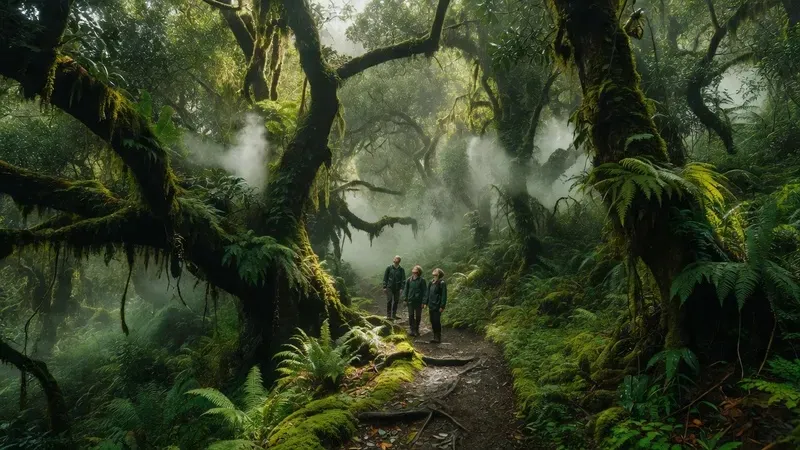
'Avatar' captures the alien visual quality: hanging mosses from every branch, ferns at multiple levels, misty light filtering through the canopy, colors in shades of green and grey that don't appear at sea level. The visual density — the layering of vegetation from the forest floor to the canopy — is what the film's designers referenced for Pandora's biosphere.
'Middle-earth' captures the ancient quality: old koa trees with massive trunk diameters, twisted root systems over ancient lava rock, the silence of the interior broken only by birds and dripping water. The forest reads as primeval in a way that young plantings don't.
Photographically, the cloud forest is excellent — the soft, diffused light from constant cloud cover eliminates harsh shadows, and the green-on-grey color palette photographs well. Wide-angle lenses capture the canopy structure; macro lenses capture the moss and fern detail.
- 'Avatar' quality: alien visual density, hanging mosses, multiple green layers, misty light — exactly what film designers referenced
- 'Middle-earth' quality: ancient trees, twisted roots over lava, primeval silence — qualities of old-growth forest
- Photography conditions: soft diffused cloud light — no harsh shadows, consistent throughout the day
- Best subjects: canopy structure (wide angle), hanging mosses (macro), endemic birds in 'ōhi'a (telephoto)
The Kona Cloud Forest Sanctuary interior — a landscape that has been described by visitors as 'Avatar' and 'Middle-earth.' The persistent mist, moss-draped koa canopy, and layered fern understory are characteristic of tropical montane cloud forests found in Costa Rica and Borneo — this is the only one in the USA.
Who Should Book This Tour and What to Expect
Who This Tour Is Best For
The Kona Cloud Forest Sanctuary tour is the most distinct from any other Kona activity — it covers a biome and landscape that exists nowhere else in the United States and looks nothing like the coastal Hawaii that most visitors experience. It's the right choice for:
- Best for: nature-focused travelers who want to go beyond the beach and ocean activities
- Best for: botany and ecology enthusiasts — the native Hawaiian plant species here are endemic, some critically endangered
- Best for: birdwatchers interested in endemic Hawaiian honeycreepers in their native habitat
- Best for: photographers looking for the most atmospheric and distinctive landscape on the Big Island
- Best for: visitors who have exhausted the standard Kona activities (snorkeling, volcanoes, manta rays) and want something genuinely different
- Best for: families with children over 10 who can handle a moderate 2.5-hour forest walk
Not Suitable For and What to Bring
The cloud forest's terrain requires basic hiking capability on uneven lava rock surfaces with some uphill sections:
- Minimum age: 10 years — younger children may find the forest walk physically demanding
- Not suitable for: guests with significant mobility limitations — lava rock surfaces are uneven
- What to bring: rain gear or a waterproof layer — mandatory. The forest is misty throughout the year and rain showers can occur at any time. A good rain jacket transforms the experience from wet to magical
- What to bring: closed-toe shoes with grip (hiking shoes preferred) — lava rock surfaces can be slippery when wet
- What to bring: camera with a telephoto lens if you want bird photographs — 'apapane move quickly in the canopy
- What to expect: 60–70°F throughout — bring a layer even in summer. This is dramatically cooler than Kona below
Kona Cloud Forest Sanctuary Tour — Frequently Asked Questions
Is the Kona Cloud Forest Sanctuary really the only tropical cloud forest in the USA?
Yes — a tropical montane cloud forest (TMCF) requires a tropical latitude, mid-to-high elevation, and persistent cloud contact. In the United States, Hawaii is the only state at a true tropical latitude. The Kona Cloud Forest Sanctuary on Mauna Loa's western slope at 3,000 feet is the only site in the USA where these conditions produce a true TMCF biome. Comparable forests exist in Costa Rica's Monteverde, the Canary Islands, and parts of Borneo.
What makes the Kona Cloud Forest different from Volcanoes National Park?
Hawaii Volcanoes National Park covers Kilauea's volcanic landscape — crater overlooks, lava tubes, steam vents, and the dramatic active geology of the Big Island. The Kona Cloud Forest Sanctuary is a living native forest preserve focused on endemic Hawaiian plants and birds in a misty, temperate biome. They are completely different landscapes and experiences. Visitors who see both on the same Big Island trip cover the island's two most extreme ecological contrasts: a fiery active volcano and an ancient, fog-draped forest.
What can I expect to see at the Kona Cloud Forest Sanctuary?
Expect to walk through a dense native Hawaiian forest with multiple canopy layers, hanging mosses, tree ferns, and ancient koa trees draped in mist. The endemic birds — 'apapane (small red honeycreepers) and 'amakihi (small yellow-green honeycreepers) — feed in the 'ōhi'a trees overhead. The atmosphere is quiet, cool (60–70°F), and misty. The visual quality is consistently described by visitors as 'Avatar-like' — a dense, layered, otherworldly green landscape unlike anything else in Hawaii.
Is the Kona Cloud Forest tour worth $156?
The value depends on what you're looking for. For visitors who want ocean activities (snorkeling, manta rays, submarine), there are better-suited tours at similar price points. For nature and ecology enthusiasts, photographers, or anyone who wants to experience a biome that doesn't exist anywhere else in the USA, the $156 is easily justified. The perfect 5.0★ rating — even from just 5 reviews — suggests the experience delivers exactly what it promises.