Captain Cook Monument Snorkeling Kona Hawaii — Kealakekua Bay, How to Get There, and What the Marine Sanctuary Actually Looks Like
At the base of a 1,400-foot pali (cliff) on the South Kona coast, a white obelisk marks the spot where British explorer Captain James Cook was killed in February 1779. The reef directly below the monument — in the protected waters of Kealakekua Bay State Marine Life Conservation District — is widely considered the finest snorkeling site on the Big Island and one of the best in the entire Hawaiian Islands. Visibility reaches 100+ feet. The reef is dense with coral and marine life because it's been protected from fishing and anchoring since 1969. Getting there requires either a boat tour or a kayak — there is no car access to the monument — which is also precisely why the reef looks the way it does.
About This Activity
Up to 24h in advance — full refund
Book today, pay nothing until later
3 unique sites: Kealakekua Bay, sea caves, remote black sand beach
Kealakekua Bay is a protected Conservation District — no fishing, restricted boat access, healthiest reef on the Big Island
Both species common in the bay — spinner dolphins shelter in the mornings, turtles feed at depth
Highest-rated snorkeling tour on the Kona coast — Sea Quest Hawaii
Check Live Availability & Prices
Real-time dates for the Sea Quest South Kona snorkeling tour — Kealakekua Bay, sea caves, lava tubes, and gourmet deli lunch included.
The Captain Cook Monument — History Behind the Snorkel Site
What Happened at Kealakekua Bay in 1779
Captain James Cook arrived at Kealakekua Bay on the Big Island of Hawaii in January 1779, during his third Pacific voyage. The timing of his arrival — during the Makahiki festival, a four-month period of peace and worship of the Hawaiian god Lono — and the appearance of his two ships in the bay created a complex cultural moment. Cook and his crew were received with considerable ceremony.
The relationship deteriorated after Cook's ships departed and then returned to the bay for repairs following storm damage. A series of incidents — including the theft of a small boat — escalated into a confrontation on the beach on February 14, 1779. Captain Cook was killed during the altercation, along with four Royal Marines.
The 27-foot white granite obelisk on the north shore of the bay was erected in 1874 by the crew of HMS Scout. The small parcel of land surrounding it — roughly a quarter acre — is technically British territory, maintained by the British government, though this status is informal and contested. The monument is visible from the water and is the visual landmark that orients snorkelers to the reef below.
- Cook's first arrival: January 17, 1779 — during the Makahiki festival period
- Cook's death: February 14, 1779 — confrontation over a stolen boat
- The monument: 27-foot granite obelisk erected in 1874 by HMS Scout crew
- Land status: informally maintained as British territory — a unique anomaly in Hawaii
- Historical significance: one of the most consequential encounters in Pacific exploration history
Kealakekua Bay State Marine Life Conservation District — Why the Reef Is So Good
Kealakekua Bay was designated a State Marine Life Conservation District (MLCD) in 1969 — making it one of the earliest protected marine areas in Hawaii. The designation prohibits commercial and recreational fishing within the bay, restricts boat anchoring to designated areas, and limits overall vessel traffic.
Fifty-five years of protection has produced a reef system that looks fundamentally different from unprotected areas. Fish that are heavily targeted by fishing — parrotfish, uhu (scrawled filefish), large wrasse, surgeonfish — are abundant and large. Old parrotfish in Kealakekua reach sizes you simply don't see at accessible shore sites. Coral cover is dense because there are no boats dragging anchor lines across it. The sheer biomass of fish in the bay is visibly different from any reef within easy shore access of Kona.
The water clarity is also exceptional — visibility consistently 80–120 feet. The bay is protected from swell by the 1,400-foot pali on the north side and generally calm conditions year-round. Afternoon trade wind chop can reduce clarity slightly at the surface, which is one reason tour boats leave early.
- Protected since: 1969 — one of Hawaii's earliest marine conservation districts
- Restrictions: no fishing, no anchoring outside designated zones, limited vessel traffic
- Result: 55 years of recovery — one of the densest, most biodiverse reefs in Hawaii
- Visibility: consistently 80–120 feet — exceptional by Hawaii standards
- Fish size: large parrotfish, old surgeonfish, big wrasse — sizes absent from fished areas
What You'll See Snorkeling at the Captain Cook Monument
Marine Life at Kealakekua Bay — What the Reef Actually Looks Like
Snorkeling at the Captain Cook Monument means entering the water directly over the reef that extends from the shoreline below the obelisk. The topography is dramatic: the reef begins at 10–15 feet and slopes through coral gardens to a wall that drops sharply past 60 feet into open blue water. The transition from reef to open ocean happens within horizontal snorkeling distance of the boat.
Coral: Mixed hard and soft coral in better condition than most accessible Hawaii reefs. Cauliflower coral (Pocillopora), finger coral (Porites), and lobe coral (Porites lobata) form the structural base. Scattered table coral extends over sandy patches between coral heads.
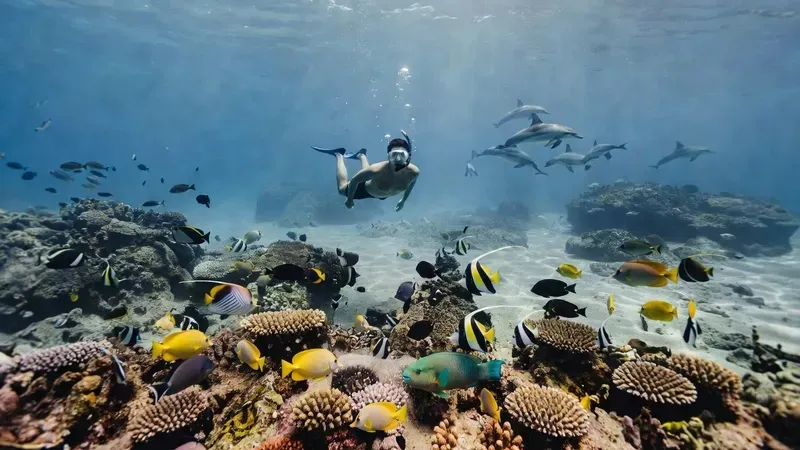
Fish: The fish life at Kealakekua is the standout. Parrotfish (uhu) in multiple species — the bullethead parrotfish, steephead parrotfish, and spectacled parrotfish — reach sizes of 18–24 inches and are everywhere. Yellow tang school in large groups. Moorish idols are common. Trumpetfish hang vertically in the water column. Whitebar surgeonfish, convict tang, and the endemic Hawaiian cleaner wrasse are consistently present.
Sea turtles: Both Hawaiian green sea turtles (honu) and occasionally hawksbill turtles (honu'ea) appear at Kealakekua. Greens graze on algae on the reef structure at 15–20 feet. Hawksbills, which feed on sponges, prefer the deeper coral heads near the wall.
Spinner dolphins: Schools of 50–200 spinner dolphins shelter in Kealakekua Bay in the mornings, resting after their nighttime feeding runs offshore. Early-morning boat arrivals frequently encounter dolphins in the bay itself — they may swim alongside the boat and interact with snorkelers at the surface.
Occasional sightings: Manta rays, whitetip reef sharks (harmless, usually resting on the sand at depth), and eagle rays appear at Kealakekua with some regularity. These are not guaranteed but more likely here than at most other Kona snorkel sites due to the bay's protected status.
- Parrotfish: large, abundant, multiple species — up to 24 inches
- Yellow tang: school in groups, the signature fish of Hawaii's reef
- Sea turtles: green sea turtles common; hawksbills occasional
- Spinner dolphins: 50–200 in the bay on most mornings (resting pod)
- Depth: snorkeling at 10–30 feet; reef wall drops to 60+ feet
- Visibility: 80–120 feet — you can see the bottom clearly from the surface
Sea Caves and Lava Tubes — Beyond the Monument Reef
The Sea Quest South Kona tour visits three distinct sites, not just Kealakekua Bay. The second and third stops are sea caves and lava tube arches along the South Kona coastline — geological features formed when lava flows reached the ocean and cooled rapidly, creating hollow tubes that are now submerged.
These sea caves are navigable by snorkelers in calm conditions: you swim through arched openings 6–10 feet wide, through short submerged tunnels, into chambers where the ceiling rises above the waterline and natural light filters through the rock. The cave walls are encrusted with encrusting coral, sponges, and echinoderms. Moray eels and soldierfish are common residents in the shadows.
Access to these caves is only possible by small rigid inflatable boat — larger vessels can't maneuver close enough. This is one of the reasons the Sea Quest RIB format produces a more varied experience than tours run on larger dive boats.
- Sea caves: submerged lava tube arches 6–10 feet wide — swimable in calm conditions
- Cave life: encrusting coral, sponges, moray eels, soldierfish, squirrelfish
- RIB boat access: only small RIB boats can navigate close enough — unique to this tour format
- Third site: remote black sand beach accessible only from the water
- All 3 sites: visited in one 5-hour tour — no other Kona tour packages these sites together
How to Get to the Captain Cook Monument for Snorkeling
Option 1: Guided Snorkel Boat Tour — The Best Way
The most efficient way to snorkel the Captain Cook Monument is a guided boat tour that departs from Kailua-Kona or Keauhou Bay. Tour boats reach the bay in 20–30 minutes, drop anchor in the designated zone, and give you 45–60 minutes of in-water time at the reef. All gear is provided, a guide is in the water, and the experience includes narration about the marine life, the bay's ecology, and the historical context of the monument.
The Sea Quest South Kona snorkeling tour (tour-4 above) is the top-rated option — 5.0★ across 96 reviews, rigid inflatable boat for sea cave access, gourmet deli lunch included, and the only tour that visits the sea caves and lava tube arches in addition to Kealakekua Bay.
Several other operators run Kealakekua Bay tours from Keauhou Boat Harbor, the launch point 6 miles south of Kailua-Kona that is closer to the bay. Price range for Kealakekua Bay boat tours: $130–$200 per adult depending on operator, boat size, and what's included. Sea Quest at $200 is at the premium end but justified by the perfect rating and the additional sea cave sites.
- Departure: Kailua-Kona or Keauhou Boat Harbor (6 miles south of Kona)
- Transit time to bay: 20–30 minutes by boat
- In-water time: 45–60 minutes at the Kealakekua reef
- Price range: $130–$200 per adult for licensed tour operators
- Sea Quest (tour-4): $200, 5.0★, includes sea caves, lava tubes, gourmet lunch
Option 2: Kayaking to Captain Cook Monument
Kayaking to Kealakekua Bay is possible and rewarding for experienced paddlers — the launch point at Napo'opoo Beach (on the south side of the bay) is about 1.5 miles from the Captain Cook Monument across the bay. Several kayak rental companies in Keauhou and Kealakekua offer kayak rentals with a launch permit included.
The paddle is straightforward in calm morning conditions but can become difficult in the afternoon when northeast trade winds funnel across the bay. Depart before 8am for the smoothest crossing. The reward is arriving at the monument before the tour boats and having the reef largely to yourself for the first hour.
Important: landing at the monument area itself (the small parcel of land with the obelisk) has been subject to access restrictions. Check current DLNR rules before planning to land — the reef access from the water is unrestricted, but landing onshore requires current research into permit requirements.
- Launch point: Napo'opoo Beach, south side of Kealakekua Bay
- Distance: ~1.5 miles across the bay to the monument
- Best departure time: before 8am — afternoon trades make the crossing harder
- Kayak rental: available in Keauhou and Kealakekua with permits
- Landing at monument: check current DLNR rules — subject to access restrictions
Option 3: The Captain Cook Trail — Hiking In (Difficult, Periodically Closed)
A 4-mile round-trip trail descends from the trailhead on Highway 11 (near the 111-mile marker) to the monument. The trail drops 1,400 feet in 2 miles — steep, exposed, and unshaded on volcanic rock. Hikers who make it to the bottom arrive at a small cove with a lava shelf entry into the marine sanctuary.
The honest assessment: the trail is physically demanding in both directions, and the descent in heat should not be underestimated. More significantly, the trail has been intermittently closed or restricted by the state due to landslide damage, liability concerns, and the impact of heavy foot traffic on the sensitive coastal ecosystem. Before planning a trail visit, check the current trail status through Hawaii's DLNR (Department of Land and Natural Resources) — closures can happen with little notice.
For most visitors, the boat tour is substantially better use of your time and energy than the trail: you get more in-water time, you have a guide, all gear is provided, and you arrive at the reef without a 2-mile descent in the sun.
- Distance: 4 miles round-trip — 2 miles each way, 1,400-foot elevation change
- Difficulty: strenuous — steep, exposed, volcanic rock, no shade
- Trailhead: Highway 11 near mile marker 111 south of Kailua-Kona
- Trail status: periodically closed — check DLNR before planning
- Honest recommendation: boat tour is better — more in-water time, guided, gear provided
Practical Guide — Captain Cook Monument Snorkeling Tips
Best Time to Snorkel Kealakekua Bay
Morning is definitively better than afternoon at Kealakekua Bay:
Spinner dolphins: The dolphin pod that shelters in the bay rests in the mornings after their nighttime offshore feeding. By 10–11am, they typically begin moving out of the bay toward open water for the afternoon feeding run. Early boats see dolphins; afternoon boats usually don't.
Visibility: Morning conditions produce glassy-calm water and the clearest visibility of the day. Afternoon trade winds (northeast, building after 11am) create surface chop that, while not dangerous, reduces photographic clarity and surface comfort.
Crowds: The bay sees both boat tours and kayakers throughout the day. Morning arrivals (before 9am) have the reef to themselves or with minimal company. By late morning, multiple tour boats may be in the designated anchor zone simultaneously.
All of this explains why Sea Quest and most quality operators run morning departures. If you're choosing between a morning and afternoon Kealakekua Bay tour, take the morning every time.
- Dolphins: present in the mornings (resting pod); usually gone by 10–11am
- Visibility: best in the morning before afternoon trade wind chop
- Crowds: minimal before 9am; multiple boats can be present by late morning
- Recommendation: take the earliest available departure without exception
What to Bring and What to Expect
The Sea Quest tour provides all snorkel equipment (mask, fins, snorkel, wetsuit top on request) and a gourmet deli lunch. What you bring is minimal:
- Reef-safe sunscreen — required by Hawaii law; standard chemical sunscreen is banned in Hawaii for reef protection
- A rash guard or light wetsuit top if you run cold — provided on request but bring your own for a perfect fit
- Underwater camera — a GoPro or similar; Kealakekua visibility makes for exceptional footage
- Arrive 15 minutes early at the Sea Quest dock for gear distribution and briefing
- Not suitable for: children under 5, pregnant women, people with back problems or mobility impairments (RIB boat boarding requires stepping down onto an inflatable hull)
- Not allowed: touching coral or marine life — federal and state protection of the MLCD carries real penalties
Captain Cook Monument Snorkeling Kona — Frequently Asked Questions
Can you snorkel at the Captain Cook Monument in Kona Hawaii?
Yes — the reef at the Captain Cook Monument in Kealakekua Bay is one of the best snorkeling sites in Hawaii. The bay is a State Marine Life Conservation District protected since 1969, with 80–120 foot visibility, dense coral, abundant fish including large parrotfish and yellow tang, sea turtles, and spinner dolphins in the mornings. You cannot drive to the monument — access is by tour boat, kayak, or a steep 4-mile round-trip hiking trail.
How do you get to the Captain Cook Monument for snorkeling?
The main options are: (1) a guided boat tour departing from Kailua-Kona or Keauhou Boat Harbor — 20–30 minutes transit, all gear provided, the most efficient option; (2) a kayak from Napo'opoo Beach on the south side of the bay — 1.5 miles across, best done before 8am before afternoon trades; (3) the Captain Cook Trail from Highway 11 — a 4-mile round-trip hike with 1,400 feet of elevation change, periodically closed, not recommended for casual visitors. Most people take the boat tour.
What marine life can you see snorkeling at Kealakekua Bay?
Kealakekua Bay's protected status since 1969 has produced one of the healthiest reefs in Hawaii. Common sightings include: large parrotfish (bullethead, steephead, spectacled — up to 24 inches), yellow tang in schools, Moorish idols, trumpetfish, Hawaiian green sea turtles (honu), hawksbill turtles (occasional), and spinner dolphins (morning pods of 50–200 animals). Less common but possible: manta rays, whitetip reef sharks resting at depth, eagle rays.
Is Kealakekua Bay the best snorkeling on the Big Island?
It is widely considered the best snorkeling site on the Big Island and one of the best in all of Hawaii. The combination of 55 years of marine protection, exceptional visibility (80–120 feet), diverse and abundant marine life, dramatic underwater topography (reef walls, sea caves, open-ocean drop-offs), and the historical context of the Captain Cook Monument creates an experience without equivalent on the island. The only limitation is access — you need a boat or kayak to get there.
Why is the snorkeling at Captain Cook Monument so good?
Kealakekua Bay has been a State Marine Life Conservation District since 1969 — 55 years with no fishing, no anchoring outside designated zones, and limited boat traffic. The reef has been recovering undisturbed for more than half a century. The result is fish biomass, fish size, and coral cover that simply don't exist at accessible shore sites where fish are regularly taken. The bay's natural topography (protected by a 1,400-foot cliff on the north) also keeps the water calm and clear year-round.
Is the Captain Cook Trail open for hiking to the snorkel site?
The Captain Cook Trail to Kealakekua Bay is periodically open and periodically closed — the state has restricted access at various points due to landslide damage, erosion, and resource protection concerns. Before planning a hike, check the current trail status through Hawaii's DLNR (Department of Land and Natural Resources). Even when open, the trail is a strenuous 4-mile round-trip with 1,400 feet of elevation change on exposed volcanic rock. Most visitors find the boat tour a better option: more in-water time, no energy spent hiking, and a guide in the water.
How long does the Captain Cook Monument snorkel tour take?
The Sea Quest South Kona snorkeling tour that visits Kealakekua Bay runs approximately 5 hours from departure to return to the dock. This includes 20–30 minutes transit to the bay, 45–60 minutes of in-water time at the Captain Cook reef, stops at sea caves and a lava tube arch (a second in-water session), a visit to a remote black sand beach, and the return transit. A gourmet deli lunch is served on board during transit.